Audible, Spotify, YouTube & Co.: The German digital audiobook market in the context of platformization
An analysis by Sven Stollfuß, first published in “New Media & Society”

Published: 10 November 2026 | Photo: AI-generated, Magnific
In short
Audiobooks in Germany have moved from CDs to downloads and above all to subscription streaming. 46% of 18- to 65-year-olds regularly listened to audio content in 2024, up from 15% in 2016.
Most listening now happens on phones and tablets. Their share of audiobook and podcast use rose from 35% in 2016 to 74% in 2023, and smart speakers are growing too.
Large multi-purpose platforms lead the market, not dedicated book services. Amazon (Audible and Amazon Music) reaches 43.3% of listeners and Spotify 40.2%. Among 14- to 29-year-olds, Spotify is clearly ahead at 52.9%.
Revenue has shifted sharply. From 2019 to 2024, sales of physical formats fell by 71.3%, while downloads grew by 77.8% and streaming by 226.9%. Bookshops hardly matter in this segment anymore.
Germany is unusual internationally: 87.4% of German-language audiobooks are consumed through subscriptions. English, French and Italian audiobooks still sell a large share as individual purchases.
Stollfuß separates “digital audiobook culture” from “platformized audiobook culture”. In the second, audiobooks are datafied cultural objects whose visibility, value and use are shaped by algorithms and platform rules.
Listening data flows back into recommendations, interface design, licensing and decisions about what gets produced. Whether a title is seen depends more on algorithmic curation than on editorial choices.
Publishers and authors are becoming more dependent on platforms whose payment models reward engagement more than unit sales. Leaving a title out of streaming catalogs is now a competitive disadvantage.
Narrators are becoming a brand factor: 49% of German listeners choose by familiar voices. At the same time, AI voices are gaining acceptance, especially among younger users, which could split the market into premium human narration and cheap synthetic audio.
The study offers an ecosystem model with six dimensions (mobile use, platform-native software, datafication, subscription economics, creative labor, infrastructural dependency) as a framework for further research. It is a conceptual model, and the author says it still needs to be tested with empirical data.
This article examines the contemporary digital audiobook through the lens of platformization and develops a conceptual framework for understanding platformized audiobook culture. Drawing on an integrative review of interdisciplinary scholarship, supplemented by market reports, industry statistics, and audience studies, it uses the German audiobook market as an analytically illuminating example through which broader processes of platformization can be explored. The article situates audiobooks within wider transformations of everyday digital media practices, highlighting the shift from physical formats toward downloads and subscription-based streaming services. Conceptually, it distinguishes platformized audiobook culture from digital audiobook culture through two complementary analytical perspectives adapted from book studies, digital publishing, and media and communication studies: an integrative platform model and a data-environment model of streaming services. Building on this synthesis, the article proposes an ecosystem model of platformized audiobook culture to support future theoretical and empirical research.
In April 2025, Spotify announced its plans to expand its audiobook offerings in German-language markets. Regarding Germany specifically, the company called the country’s rich tradition a key factor driving the current popularity and success of audiobooks, which have become “a significant part of the cultural landscape, preserving and promoting literature in a modern format” (Spotify, 2025a). Indeed, audiobook usage continues to rise. According to the Audible Compass (2024), 46% of Germans aged 18 to 65 regularly listened to audio content – including audiobooks, audio plays, and podcasts – representing a 12% increase in listeners compared to the previous year. Thus, the audiobook is entering a golden era, as highlighted in a whitepaper by the Frankfurt Book Fair (2024) and Börsenblatt (2024). This aligns with the dynamic transformations driven by digital media and processes of platformization (Davis, 2020; Parnell, 2021; Spjeldnæs, 2022), as consumption habits have shifted from physical formats (e.g., audiobooks on CD) to digital downloads and streaming services, with the streaming model experiencing the sharpest growth (Frankfurt Book Fair, 2024: 19).
The expansion of audiobooks in everyday culture has been closely tied to the increasing use of mobile media applications on handheld devices such as smartphones and tablets, as well as their integration with streaming services and wireless smart speakers (Vogel, 2022: 87). As Kari Spjeldnæs and Faltin Karlsen note (2024: 293), literature has become increasingly intertwined with platform-driven digital media, as publishing, reading, and writing practices adapt to the affordances of a connected mobile media environment. In this context, audiobooks have emerged as culturally relevant media that reconfigure the position of printed books as key formats for accessing literature (Have and Stougaard Pedersen, 2020; Linkis and Pennlert, 2026; Spjeldnæs and Karlsen, 2024: 292; Tattersall Wallin and Nolin, 2020). App-based services have become especially important in this development, not least because “platforms have become a key feature of the contemporary publishing industry” (Parnell, 2021: 526). More broadly, platformization as a macro-concept, along with its data-driven modes of governance operating across heterogeneous platform forms, has become a defining feature of contemporary platform societies (van Dijck et al., 2018). The rapid growth of audiobooks is deeply entangled with these dynamics. Although audiobooks long predate digital infrastructures through formats such as cassette tapes and CDs, their recent emergence as a rapidly expanding market segment has been driven by digital technologies and platform-based dynamics (Berglund, 2024: 29–50; Kovač et al., 2019: 324–325). Streaming, in particular, has become a dominant business model through which the cultural and economic organization of digital audiobooks is structured (Linkis and Pennlert, 2026: 2).
Previous research has already situated audiobooks within digital book cultures (Berglund, 2024), examined platform-driven transformations of audiobooks through subscription-based streaming models (Colbjørnsen, 2021; Kristensen and Lüders, 2023; Linkis and Pennlert, 2026) and explored changing listening practices, remediation processes, digital publishing, and the commodification of literary content on platforms (Spjeldnæs, 2022; Tattersall Wallin and Nolin, 2020). In this context, the article argues for a theoretically and analytically diversified perspective on platform-driven audiobooks, treating them as conceptually distinct from the digital audiobook. It conceptualizes these developments through the notion of platformized audiobook culture, situating it within the broader reconfiguration of digitally networked cultural and economic infrastructures. In this sense, the article aims to provide a theoretically grounded discussion and definition of platformized audiobook culture. To support this aim, it develops an ecosystem model as an analytical framework. In doing so, the article contributes to the growing body of scholarship on the transformation of audiobooks through digital technologies, platform-driven dynamics, and streaming media. By synthesizing a theoretically nuanced conceptualization of platformized audiobook culture with an analytically differentiated ecosystem model, the article offers a framework for future theoretical and empirical research.
The argument proceeds in three steps. First, I discuss the digital audiobook within the context of platform- and data-driven transformations of everyday media use, drawing on existing approaches to digital audiobook culture as an analytical baseline from which platformized audiobook culture can be distinguished. Second, I adapt two complementary models from interdisciplinary research in book studies, digital publishing, and media and communication studies: Simon Rowberry’s (2017) layered platform model, developed primarily for e-books, and Karl Berglund and Sara Tanderup Linkis’s (2022) data-environment model of streaming services. I then apply these perspectives to the German audiobook market, drawing on studies of changing media use, sales statistics, and developments in the book industry. Third, building on this analysis of the German market, I further develop and integrate the two models into a conceptual framework and ecosystem model that conceptualizes platformized audiobook culture as a multilayered sociotechnical and economic formation in which user practices, technological infrastructures, production networks, platform governance, and data environments are mutually constitutive.
The German case is not treated as representative of all audiobook markets. Rather, it serves as an analytically revealing example through which broader processes of platformization can be examined: audiobook consumption is increasingly organized through subscription-based streaming services, global platform providers dominate distribution, revenues have shifted rapidly toward streaming, and audiobooks have become embedded in everyday mobile media practices. While platformization manifests differently across national contexts due to variations in market structures, dominant platform actors, publishing practices, and patterns of everyday mobile media use related to streaming, the proposed ecosystem model is conceived as an analytically adaptable and conceptually open framework that can be applied across different audiobook markets.
Methodologically, the article adopts an integrative review approach (Torraco, 2005), synthesizing interdisciplinary scholarship and secondary empirical material, including market reports, industry statistics, and representative audience surveys on the German audiobook market. These sources are not used to provide a comprehensive empirical analysis but rather to illustrate and contextualize key dynamics of platformization.
Streaming audiobooks: Data and platformization as key and challenge
Digital platforms – from social media to streaming services – have largely affected current media culture through data-driven interface policies that restructure online communication (Helmond, 2015). As platforms have evolved into central “political-economic formations” (Faulkner-Gurstein and Wyatt, 2023: 891), they increasingly shape organizational practices through the data-extractive logics of platform capitalism (Srnicek, 2017). These dynamics, captured by the concept of a “platform society” (van Dijck et al., 2018), pose significant structural and strategic challenges for established media companies and organizations, particularly in reaching younger, digitally native audiences who prioritize mobile media and online platforms, including but not limited to streaming services. While platformization describes a broader sociotechnical process of restructuring cultural production, distribution, visibility, and consumption through data-driven digital infrastructures (Helmond, 2015; Nieborg and Poell, 2018), streaming denotes a specific mode of media distribution that can be organized through various business models, including subscription-based, transactional, electronic sell-through, and advertising-funded approaches (Chalaby, 2024; Colbjørnsen, 2021). Although subscription-based streaming currently represents the dominant mode of audiobook platformization in markets such as Germany, platformized audiobook culture should not be reduced to a single platform model. Audiobooks circulate across heterogeneous platform environments (Berglund and Linkis, 2022: 7–10; Weber, 2026a: 197), including all-you-can-listen subscription services, credit-based systems, transactional marketplaces, and advertising-funded platforms. While these configurations differ in their remuneration structures, visibility mechanisms, and modes of user engagement, they share broader tendencies toward datafication, algorithmic mediation, and platform governance.
Amid ongoing technological and media-cultural transformations, the streaming-platform landscape has become increasingly diversified in recent years. Users are offered a wide range of services for video (e.g., Netflix, Amazon Prime Video, Disney+, Apple TV+, and HBO Max), audio (e.g., Spotify, Apple Music, Amazon Music, and YouTube Music), and digital book consumption (e.g., Amazon Kindle Unlimited, Skoobe, and Nextory), each organized through distinct platform infrastructures and business models. At the same time, media practices are becoming increasingly embedded within – and shaped by – the sociotechnical architectures, norms, and governance structures of dominant platforms.
This growing alignment with digital platforms has significant implications for how culture is understood and organized. Discussing streaming platforms such as Netflix, Hallinan and Striphas (2016) draw on Raymond Williams to argue that “culture may refer to particular modes of fostering human refinement, and their underlying frameworks of valuation and authority; patterns of social difference, commonality, and interaction; and the artifacts, particularly aesthetic objects, associated with specific groups of people” (p. 119). From a Cultural Studies perspective, Williams (2001: 57–88) understands culture not only as a body of artistic works or a set of normative values but also as a particular way of life expressed through everyday practices, institutions, and processes of meaning-making. This latter perspective is especially relevant for analyzing contemporary media cultures. Similarly, Hepp (2013: 4) argues that culture is grounded in the production of meaning in everyday life, a process now deeply intertwined with media technologies and infrastructures.
Against the backdrop of increasingly data-driven and platform-oriented everyday life, algorithmic operations have become central to the organization of culture. Hallinan and Striphas (2016: 119; see also Striphas, 2015) describe this development as “algorithmic culture,” emphasizing how algorithms sort, rank, and classify both people and cultural content while simultaneously shaping habits, preferences, and behavior. Similar dynamics can be observed across platform ecosystems such as Amazon, where processes of ranking, recommendation, surveillance, and data extraction increasingly structure both cultural production and consumption (Davis, 2020: 87–98). As a result, cultural practices are becoming embedded within datafied platform environments in which software systems, algorithms, and platform governance play an active role in shaping participation and meaning-making (Ludovico, 2023: 51–92; van Es and Schäfer, 2017). Datafication, understood as “the transformation of social action into online quantified data, thus allowing for real-time tracking and predictive analysis” (van Dijck, 2014: 198), has made data collection and evaluation central to nearly all social and cultural processes (Hepp, 2016: 229). The concept of platformized audiobook culture developed in this article builds on these approaches while shifting the analytical focus toward the platform-driven reconfiguration of digital audiobooks under contemporary streaming-based modes of distribution and use.
Digital audiobook culture: Establishing a baseline
In the context of media change following the proliferation of the internet and the rise of online-based media, the digital audiobook has already been discussed as a phenomenon of transformation (Berglund, 2022), with the book being conceptually elaborated as an “information architecture”: “It can be rendered in many ways, including electronic-visual and audio (talking books)” (Cope and Phillips, 2006: 8). However, as Linn-Birgit Kristensen and Marika Lüders (2023: 184) have recently argued, printed books – and their established modes of access and use – have shown a remarkable resilience to structural change compared to other media such as film and television. While e-books were once expected to introduce disruptive dynamics (Davis, 2015: 519; Rowberry, 2022: xiv), their economic establishment and cultural adoption remain relatively limited, even in light of technological advancements in recent years (Rowberry, 2022: 1–25), as many readers continue to prefer physical books over digital formats, although they appear to support their development in principle (Bergström and Höglund, 2020: 903; Kampen Kristensen, 2019; Kristensen and Lüders, 2023: 184; Loh and Sun, 2019). In contrast, audiobooks have undergone significant developments toward an “experiential shift” in how and when they are accessed and consumed (Kristensen and Lüders, 2023: 184). When used with everyday mobile devices like smartphones, audiobooks are considered an innovative medium that also encourages more diverse patterns of media use, especially among people with disabilities, individuals with literacy difficulties, and non-native language learners (Casselden and Paxton, 2025: 896; Have and Stougaard Pedersen, 2020: 413). Moreover, unlike other digital book formats – such as e-books, which largely replicate the reading habits associated with print media – audiobooks appear more adaptable to the temporal patterns of everyday use, reflecting the flexibility of the medium (Berglund, 2022).
While the concept of digital audiobook culture has only emerged in recent years and has not yet been widely formalized in scholarly discourse (see, for instance, Berglund, 2022: 5, 120; Weber, 2026b: 4, on the Audiobooks and Digital Book Culture survey; cf. also Weber, 2026a: 183–187, on the development of the digital audiobook within audiobook studies), existing research on digital audiobook listening, digital publishing, and streaming consumption provides a solid basis for further conceptualization. In transforming the landscape of digital book formats, audiobooks can be seen as an infrastructural driver, as both patterns of use and economic dynamics are shifting with the expansion of streaming. In that sense, Elisa Tattersall Wallin and Jan Nolin (2020: 473) put it, “The remediation into subscription-based digital audiobooks [. . .] can be seen as a remediation not only of the audiobook into a new format but also as a remediation [. . .] with the many dramatic changes in distribution, economic actors, practice and readership.” Tattersall Wallin and Nolin’s work is particularly important because it foregrounds the dimension of cultural practices. They argue that subscription-based audiobooks reshape not only the format of the audiobook but also its distribution, reading-as-listening practices, and users’ everyday routines. Digital audiobook culture is thus characterized by particular “timespaces” of reading-as-listening and by a shift from stationary to mobile forms of engagement, reorganizing reading into digitally connected and increasingly always-on everyday practices (Tattersall Wallin and Nolin, 2020: 483–485). At the same time, their approach primarily conceptualizes digital audiobook culture through user practices, emphasizing how printed books are remediated into subscription-based streaming content (p. 485). Building on this perspective, Tattersall Wallin (2022a) shows how audiobooks have become embedded in everyday routines, particularly among younger users. Enabled by smartphones and headphones, audiobooks allow reading to be combined with activities such as commuting, exercising, and household chores. Their convenience and flexibility have made them an integral part of contemporary mobile media culture, demonstrating how platform-based audiobook use is increasingly intertwined with everyday practices and routines (see also Tattersall Wallin, 2022b: 48–73).
Iben Have and Birgitte Stougaard Pedersen (2020: 410) likewise define the audiobook as “an audio recording of a (previously or simultaneously) published written book, performed by a narrator who could be the author, a professional actor or an amateur, or a synthetic voice.” They emphasize that audiobook use relies on a broader technological ecology that includes smartphones, headphones, smart speakers, and related listening devices (pp. 417–422; Vogel, 2022: 87). Moreover, the audiobook constitutes a distinct sensory mode of engagement based on sound media technologies and increasingly convergent media environments in which users can move seamlessly between text and audio formats (Have and Stougaard Pedersen, 2020: 422). Their understanding of the smartphone as a convergence medium linking multiple audio formats and online services helps identify key features of digital audiobook culture: device-based mediation, sensory differences from print, mobility, and the audiobook’s relocation from the margins to the center of digital publishing (p. 410). Likewise, Berglund and Linkis (2022) show how subscription-based streaming reshapes the publishing chain and constitutes books, particularly audiobooks, within streaming systems. Yet despite their attention to database organization, recommendation systems, platform centrality, and data-driven forms of production and distribution, they stress that “streamed audiobooks” (p. 17) remain “primarily defined by and closely connected to traditional book culture.”
Platformized audiobook culture: Toward a conceptual characterization
Nevertheless, while streamed or platformized audiobooks remain closely connected to print-based book culture, they no longer seem to be “primarily” defined by it. This shift reflects the growing influence of streaming infrastructures, platform governance, and data-driven forms of coordination. Colbjørnsen (2021) argues that streaming platforms constitute a political economy of streaming culture in which data flows, platform power, and infrastructural relations between publishers, platforms, devices, and users generate asymmetrical dependencies. As platform providers increasingly control content provision and can bundle software, services, and hardware, they occupy particularly powerful positions within these networks (pp. 1282–1283). Similar dynamics are identified by Sara Tanderup Linkis and Julia Pennlert (2026) in their analysis of the Swedish audiobook market. They show that audiobook production is increasingly shaped by platform logics and commercial optimization, with publishers and authors becoming more dependent on the values and infrastructures of streaming services (p. 13). Therefore, as Linkis (2025) argues, subscription-based services transform literary content from a product that can be purchased and owned into a service accessed through digital platforms, where its value is increasingly measured through user engagement metrics. Consequently, platformized audiobook culture is best understood not primarily through its relationship to print culture but through its embedding in connected platform ecosystems characterized by ubiquitous connectivity, algorithmic attention management, and data-driven forms of cultural organization (see also Linkis, 2025; Spjeldnæs and Karlsen, 2024).
These transformations call for an understanding of digital audiobooks that accounts for the data-driven and infrastructural dynamics of platformization (Helmond, 2015; Nieborg and Poell, 2018). The rise of companies such as Alphabet, Meta, Apple, Amazon, and Microsoft as providers of “infrastructural platforms” (van Dijck et al., 2018: 12–16) has profoundly shaped contemporary digital media culture. Platformization refers to the expansion of digital platforms and the reorganization of online environments through platform programmability, data extraction, and the integration of third-party services via software interfaces and platform ecosystems (Helmond, 2015: 1, 5–7). This ecosystem signals a transformation across technological, social, cultural, economic, and political domains, fostering and accelerating one-sided dependencies on conditions imposed by platforms (Nieborg and Poell, 2018: 4277). Platforms are not neutral intermediaries; they actively shape the visibility and accessibility of content. In the context of digital audiobooks, platforms reshape cultural production through their infrastructural logics by transforming how audio content is produced, published, received, and used. These processes increasingly conform to the sociotechnical logics of digital platforms and become dependent on their infrastructural ecosystems. Structured by algorithmic governance and data practices, platforms curate content, regulate its visibility, and translate attention and popularity into economic value within platform ecosystems.
From this perspective, a characterization of platformized audiobook culture can be developed in two steps. First, in line with the existing literature (Berglund, 2022; Berglund and Linkis, 2022; Have and Stougaard Pedersen, 2020; Tattersall Wallin and Nolin, 2020), digital audiobook culture can be understood as a form of contemporary book culture in which literary texts are accessed as recorded audio through digital devices and networked services. This transformation reshapes reading into listening and reorganizes literary experience through mobility, sensory difference, convenience, and changing temporal routines of everyday media use. It is marked by the audiobook’s transition from a rather supplementary format of printed books to a central medium of digital publishing and reading-as-listening (Have and Stougaard Pedersen, 2020: 410).
Second, through conceptual modification and theoretical expansion (Berglund, 2024; Colbjørnsen, 2021; Linkis and Pennlert, 2026; Spjeldnæs and Karlsen, 2024), platformized audiobook culture can be understood as a sociotechnical and cultural formation in which digital audiobooks are no longer merely digitized literary recordings but datafied and algorithmically organized cultural objects operating within predominantly subscription-based platform ecosystems (Linkis and Pennlert, 2026). Their production, distribution, circulation, discovery, valuation, and everyday use are increasingly structured by platform infrastructures, algorithmic governance, and data-driven forms of coordination. As such, platformized audiobook culture is characterized by mobile and ambient listening, proprietary app ecosystems, recommendation and ranking systems, continuous behavioral data extraction, subscription-based access, and growing dependencies on large-scale platform operators that shape cultural visibility, market dynamics, and user practices within the audiobook sector (Linkis, 2025; Stougaard Pedersen, 2024). To further elaborate this conceptualization, I now examine platformized audiobook culture through the German audiobook market as an analytically revealing case.
Platformized audiobook culture and the German market: A conceptual approach
In Germany, according to representative studies such as the ARD/ZDF Media Study (2025), the consumption of audio content ranks second in relevance after video, with 79% of German citizens using audio content on a daily basis in 2025. Therefore, nearly four out of five people listen to audio content daily, and audio accounts for a substantial share of overall media consumption time. Although radio consumption continues to dominate among the average demographic, users aged 14–29 increasingly prefer streaming over linear channels such as radio (40%), with music streaming ranking first at 54% (Gattringer, 2025: 6). While this demographic shows a growing preference for time-independent, mobile audio consumption, the streaming of podcasts (42%) and audiobooks (23%) – alongside music – is also on the rise (Gattringer, 2025: 9). This trend is particularly evident in sectoral surveys such as the Online Audio Monitor (2025), the Audiobook Global Growth Report (Frankfurt Book Fair, 2024) or the Audible Audio Compass (2024), the latter of which documents a steady rise in podcast and audiobook consumption among Germans, from 15% in 2016 to 46% in 2024.
Perspective on mobile media and platform-integrated use
Device-related data further supports the shift toward platform-based consumption: the proportion of users accessing audiobooks and podcasts via smartphones and tablets has increased markedly in recent years, rising from 35% in 2016 to 74% in 2023 (Audible Compass, 2023; Statista, 2024). Mobile devices such as the smartphone thus function as key convergence technologies (Fortunati, 2023; Miller, 2014), enabling constant access to audio content and reinforcing usage patterns aligned with platform logics such as personalization, mobility, and continuous availability. Regarding usage motivations, the Online Audio Monitor (2025: 26) shows that younger users aged 14 to 29 primarily value audiobooks and other audio formats for relaxation, emotional wellbeing, and everyday enjoyment. Many use them to unwind, improve their mood, or make everyday situations more pleasant. The findings also indicate that audio content has become embedded in daily routines, with substantial shares reporting that they would miss it or regard it as a natural part of everyday life. In addition, audiobooks serve important social functions, providing a sense of companionship and helping users avoid feelings of loneliness. Practical motivations, such as gaining advice, discovering new topics, and staying informed about local events, also play a role. These findings closely align with Tattersall Wallin’s (2022a) analysis of digital audiobooks in everyday culture. Both studies emphasize the integration of audiobooks into routine activities and highlight their role in wellbeing, relaxation, and companionship. While Tattersall Wallin develops a more detailed typology of listening practices, both studies suggest that younger users perceive audiobooks primarily as mobile, comforting, lifestyle-oriented companions within a platform-driven everyday culture.
Analytically, this leads to a conceptual understanding of handheld devices as means of accessing and using audio content in relation to the surrounding data environment. To this end, I draw on a generic platform model introduced by Simon Rowberry (2017: 290–300). Although Rowberry focuses on the development of e-books for dedicated e-readers, he proposes an integrative platform model that highlights the distinctive features of digital book forms within platform environments. I therefore apply this model to platformized audiobooks accessed via devices such as smartphones (Figure 1). The model adopts a layered platform approach that conceptualizes audiobook consumption as a system of interrelated elements rather than as a single medium or product. Although analytically simplified, its strength lies in demonstrating how cultural consumption is structured through stacked technological, infrastructural, economic, and cultural layers, each of which conditions how audiobooks are distributed and used. At the base, hardware (smartphones, tablets, headphones, smart speakers) establishes the material conditions of access. While smartphones continue to lead, growth in the use of smart speakers for audio content in general is also gradually noticeable, increasing from an 8.3% daily reach in 2019 to 23% in 2025 (Online Audio Monitor, 2025: 64). However, this layer foregrounds mobility and ambient listening as defining features also of audiobook use, situating listening within everyday routines rather than in fixed reading-as-listening situations. According to the Online Audio Monitor (2025: 88–89), when on the move, online audio is a constant companion particularly for younger German users – not only in cars, buses, or trains, but also during sports or other out-of-home activities. At home, younger audiences tend to consume online audio mainly as a secondary activity – during (household) chores, while browsing the internet, or gaming – whereas older listeners more often devote their full attention exclusively to the content. Hardware thus already shapes temporal patterns of use and forms of attention (Tattersall Wallin and Nolin, 2020).
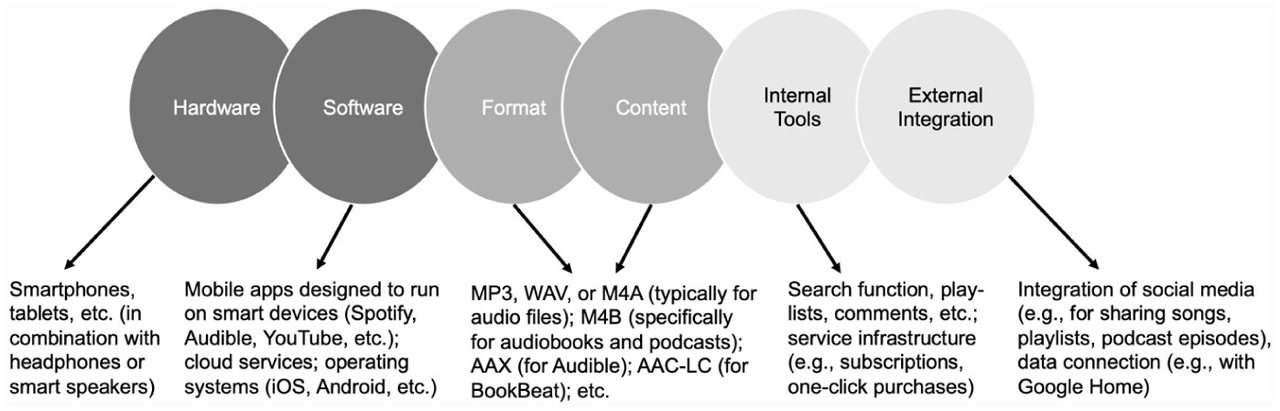
Figure 1. Integrative platform model (adapted and modified from Rowberry, 2017: 292–300).
The software layer introduces platform logic in its operational form. Mobile applications, operating systems, and cloud services mediate access to content and structure user interaction. At this level, platform power becomes particularly visible: software not only enables playback but also organizes navigation, personalization, and data capture. This infrastructural mediation contributes to growing concentrations of control and increasingly intensive forms of datafication – processes recently theorized as “hyperdatafication” (Bhandari et al., 2026). Platformized audiobook consumption is therefore inseparable from app design and operating-system ecosystems. In Germany, audiobook consumption among the general population is dominated by Amazon’s services, Audible and Amazon Music, which together reach 43.3% of users. These are followed by Spotify (40.2%) and YouTube, along with Google Play Books (40.2%). In the 14–29 age group, the pattern differs slightly: Spotify is the leading platform for audiobook consumption (52.9%), followed by YouTube (40.8%), Amazon Music (20.2%), and Audible (20%; Online Audio Monitor, 2025: 83–84). These figures illustrate that audiobook consumption is increasingly embedded within broader platform ecosystems rather than dedicated book infrastructures. As a result, the distribution, discovery, and use of audiobooks become dependent on the software architectures, recommendation systems, and data practices of a small number of global platform providers.
In that context, the format layer highlights that audiobooks are not neutral carriers of content. Proprietary and semi-proprietary formats (e.g., AAX and AAC-LC) tie content to specific platforms and services, reinforcing lock-in effects. Analytically, this layer links technical standards to economic control, as formats also become instruments of market enclosure. At the level of content, audiobooks appear as cultural products – but crucially as products already shaped by platform conditions. Content is selected, organized, and made visible through database logics rather than through traditional catalogs or bookstores. This reinforces the idea that platforms do not merely distribute content but actively recontextualize it (Spjeldnæs, 2022: 784–785). The internal tools layer makes explicit how platforms translate use into value by means of usability. Search functions, playlists, comments, subscriptions, and one-click purchases operationalize user interaction while simultaneously generating data (Berglund and Linkis, 2022: 11–13; Colbjørnsen, 2021: 1271–1281). This layer is central to understanding datafication: consumption is continuously tracked, analyzed, and fed back into recommendation systems and business decisions (Colbjørnsen, 2021: 1265). Finally, external integration situates the platform within a broader digital ecosystem. Social media sharing, smart home integration, and data connections extend audiobook consumption beyond the platform itself, amplifying visibility, reinforcing network effects, and further embedding listening practices into everyday digital life.
Taken together, the model demonstrates that platformized audiobook culture is not defined solely by audio content or listening practices, but by the coordination of hardware, software, formats, interfaces, and data flows. It analytically supports an understanding of digital audiobooks as mainly platform-native cultural forms, shaped by algorithmic governance, infrastructural dependency, and data-driven business models – rather than as simple digital equivalents of print books.
Perspective on streaming platforms as data environments and markets
Embedded in a platform-oriented digital everyday culture, the platformization of audiobooks thus entails serving a data-driven ecosystem that subordinates sectoral actors to its infrastructural logics (Spjeldnæs, 2022; van Dijck et al., 2018). In the global audiobook market, the effects of platformization are most clearly evident in the form of market concentration among major technology corporations such as Spotify, Google, and Amazon. Among these actors, Spotify – as the leading platform among the younger audiobook users in Germany – has attracted particular critical attention for its cultural and economic expansion through “surveillance and private data brokerage, precarious creativity, platform capitalism, and the unregulated global proliferation of intermediaries” (Vonderau, 2019: 5). As Patrick Vonderau (2019: 5) argues, Spotify’s interaction design reorients content consumption around behaviors and affective states, mediated through curated playlists and frequently updated motivational messaging. In such an environment – where content becomes data and data serves as material for large-scale user targeting – the accessibility of cultural forms, including songs and audiobooks, demands critical reflection in light of platformization. Platform ecosystems enforce and exploit frameworks for cultural activity that serve data-extractive models (Srnicek, 2017) by encouraging users to engage in routine, data-generating cultural practices through platform-provided features (e.g., mood-aligned playlists), thereby sustaining user engagement and steering users toward fee-based services such as subscriptions (Berglund and Linkis, 2022).
Analytically, this gives rise to a second conceptual model for understanding platformized audiobook culture within the cultural and economic framework of streaming platforms and their providers. As Colbjørnsen (2021) has shown, power dynamics based on data flows are complex among the various actors within streaming networks, particularly in relation to content publishing, content origination, device control, and advertising. In general, a streaming service manages a content database that users access via a mobile app on a device, typically in exchange for a fee, most often through subscriptions. While streaming platforms do not primarily produce original content, some providers such as Audible or Storytel are a partial exception through their provision of “originals.” This also points to the need for greater theoretical and analytical attention to originals as an additional area of research within platformized audiobook culture (see also Linkis and Pennlert, 2026). More commonly, however, publishers grant these platforms access to their content in return for payment (Colbjørnsen, 2021: 1273–1275). This model foregrounds both monetary flows between users, platforms, and publishers and parallel flows of user data. As consumption data has become a key asset in the digital economy, it is leveraged not only to optimize platforms but also to generate revenue through data monetization (pp. 1271–1272).
As an extension of Colbjørnsen’s generic model, Berglund and Linkis (2022) offer a more detailed framework for analyzing audiobooks within subscription-based streaming services in particular. Their approach places the streaming service at the center (Figure 2). Although the model does not encompass the entire book trade – excluding, for example, print production and distribution, unit-based audiobook sales, libraries, and other key intermediaries – it effectively highlights how this specific segment operates and how it can be situated within a digital publishing framework for audiobooks. Building on this, and in combination with the previously discussed integrative platform approach, I discuss key elements of platformized audiobook culture using the German market as a case study. For analytical clarity, I emphasize those sections of the model (see the gray-highlighted fields in the figure) that are particularly relevant to understanding the transformations driven by the platformization of digital audiobooks.
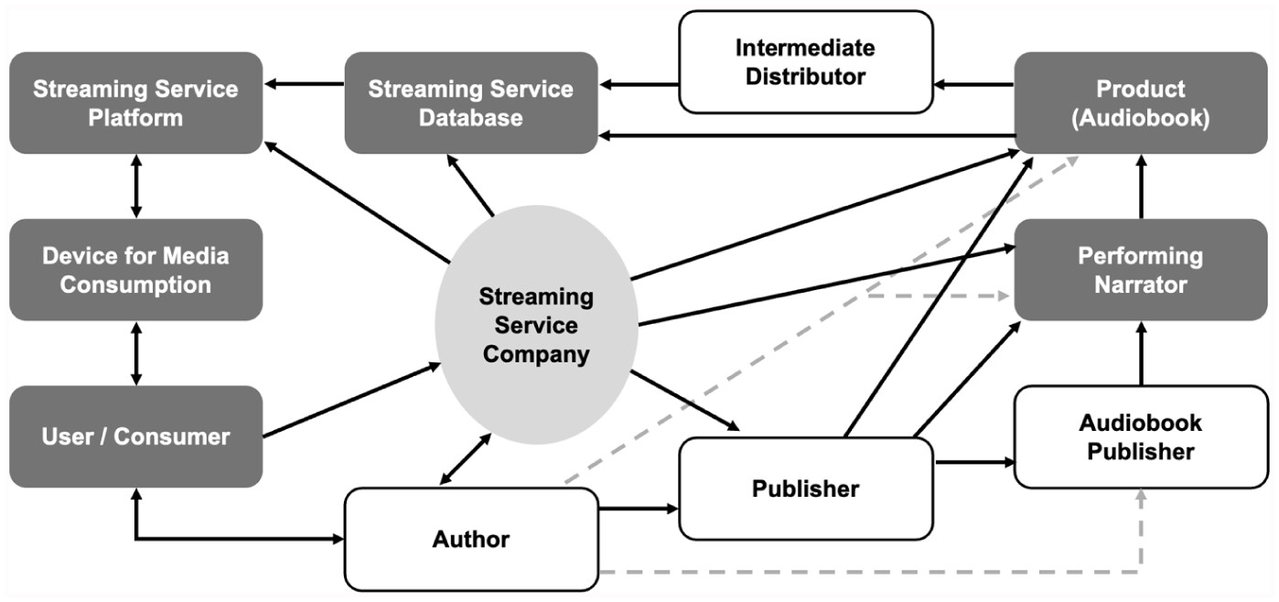
Figure 2. Model of subscription-based streaming for audiobooks (adapted and modified from Berglund and Linkis, 2022: 8).
The model addresses the product; for this article, that is solely the platformized audiobook produced by publishers or similar actors. Berglund and Linkis treat the product as a distinct component of the model, enabling its analysis within streaming services (e.g., in terms of genre popularity, playlist curation, and trending recommendations). In addition, the model includes the streaming service platform as a separate element positioned between the product database and the hardware device used for consumption. Within platform ecosystems, data environments are embedded in infrastructural providers, enabling sector-specific services to participate in shared data flows. While users access individual applications through their devices, they simultaneously become part of the data environment of the underlying infrastructure provider. A case in point is the close cooperation between Spotify and Google, which enables music streaming on Google devices (Home) through Google Cloud–based infrastructure. Users can link their Spotify accounts in the Google Home app, while data processing is handled through Google Cloud (Spotify, 2025b). This configuration, thus, highlights the importance of interfaces (to connect users with content under conditions of responsive design and app usability), underlying algorithms, and recommendation systems in audiobook consumption (that determine and accelerate visibility and findability).
The model also draws attention to the performing narrator as a key component of the audiobook format. As indicated by the Audible Audio Compass (2024), 49% of German listeners are guided by familiar voices, while 37% actively seek out well-known narrators; moreover, 71% research additional titles by narrators whose performance appealed to them. At the same time, advances in AI voice optimization – together with a growing number of users who are losing their reservations toward non-human audio content – are already contributing to the rise of AI-narrated audiobooks. According to the Online Audio Monitor (2025: 51), acceptance of AI-generated voices and content is significantly higher among younger users. While this development is currently most pronounced in functional genres such as news, information, and navigation, users aged 14–29 are also comparatively less skeptical of AI-generated content. This growing acceptance suggests that streaming platforms may accelerate the integration of AI-generated voices into audiobooks and other audio formats, further entrenching automation, scalability, and data-driven production logics. As emphasized in a recent white paper by the Frankfurt Book Fair on AI and Audio (Frankfurt Book Fair, 2025: 42–43), AI-generated voice production is rapidly approaching – and in some cases already surpassing – human narration in English-language markets. In this context, publishing professionals express concern that this “new audio landscape” may lead to a bifurcated market, in which premium human narration competes with increasingly sophisticated and low-cost synthetic alternatives, raising challenges for quality, cultural value, and platform governance (Frankfurt Book Fair, 2025: 43).
Berglund and Linkis’ model focuses on the business model of subscription-based streaming, in which a streaming service company provides access to a content database. This database consists primarily of titles supplied by publishers, but may also include content produced by the platform itself (e.g., Audible or Storytel Originals) as well as works by self-publishing authors. Publishers or self-publishers seeking inclusion on a streaming platform may negotiate directly with the service – an option largely limited to larger actors – or work through an intermediary distributor. In Germany, a prominent example is the Frankfurt-based Bookwire, which provides e-book and audiobook distribution, as well as print-on-demand services, to approximately 2,300 publishers worldwide through its digital platform Bookwire OS – One Solution (Bookwire, 2026).
With regard to business approaches, subscription-based streaming clearly dominates the German market. Correspondingly, the growth of online audio and audiobook consumption has led to the characterization of the platformized audiobook market as having a dual structure, consisting of a small number of large providers alongside a range of smaller ones. Age-group comparisons further indicate that younger users are particularly oriented toward multifunctional platforms. Accordingly, Amazon’s services Audible and Amazon Music, Spotify, and YouTube, along with Google Play Books, are the leading platforms for audiobook consumption. In addition, a range of smaller services contributes to daily audiobook use and supports further platform diversification, including audio libraries and radio websites (12%), Apple Books (9.4%), BookBeat (8.6%), and Storytel (3.1%; Online Audio Monitor, 2025: 84). At the same time, audiobook revenue shares reveal a significant structural shift. Revenue generated through traditional book retail and physical media (CDs) has declined continuously and sharply in recent years, dropping by 71.3% between 2019 and 2024. Conversely, digital formats have expanded substantially, with revenues increasing by 77.8% for downloads and by 226.9% for streaming services (Börsenverein des Deutschen Buchhandels, 2025). Thus, on the German market, the breakdown of audiobook revenue by distribution format indicates a clear relocation of economic value and market power toward digital platforms. Downloads – and above all, streaming services – now dominate the market, while CDs have become marginal. Consequently, in the German audiobook market, economic growth through shifting revenue shares, as well as the increasing cultural value generated by the everyday use of digital audiobooks on digitally connected mobile media, is largely determined by streaming-platform providers. Traditional book retail and physical media have lost much of their economic and cultural relevance, rendering conventional bookshops nearly irrelevant within today’s platformized audiobook culture. Publishers, likewise, have to adapt to the conditions set by streaming providers, as streaming has emerged as the fastest-growing segment of the German audiobook market and increasingly structures its economic conditions (Börsenverein des Deutschen Buchhandels, 2025; Schulte, 2025).
The particularly strong growth of streaming compared to previous years underlines the centrality of subscription-based models. In addition, the Audiobook Global Growth Report published by the Frankfurt Book Fair (2024) highlights significant differences in language-specific business models. A comparison of unit sales, subscription usage, and library lending shows that German-language audiobooks are overwhelmingly consumed via subscription services (87.4%), whereas others like English-, French-, and Italian-language audiobooks retain comparatively strong unit sales (50.3%, 64.3%, and 71.9%, respectively). This suggests that platformization does not unfold uniformly but instead interacts with linguistic markets, catalog availability, and patterns of global content circulation (Frankfurt Book Fair, 2024: 54–57; for the Swedish market see also Berglund and Linkis, 2022: 9).
In Germany, global platform providers with subscription-based business models are therefore benefiting from recent dynamics of platform-oriented audiobook use, which is embedded in everyday cultural consumption practices on multifunctional, content-diverse services such as Spotify and YouTube. As a result of the perceived ubiquity of content on streaming platforms, readers increasingly expect new titles to be available as audiobooks, making exclusion a competitive disadvantage – particularly for large and mid-sized publishers (Berglund and Linkis, 2022: 10). This dynamic is closely tied to the role of consumption data generated through user interactions and aggregated by streaming service providers. While datafication and tracked reading are broader trends in digital culture, Berglund and Linkis argue that subscription-based streaming services rely more heavily on consumption data than other book distributors, thereby influencing the entire audiobook production chain. Such data are used to optimize recommendation algorithms, shape platform design, and inform content decisions (pp. 11–17). Taken together, the media-cultural transformations shaped by platformization and data processes have led to a platformized audiobook culture that is increasingly embedded in a streaming-platform ecosystem, restructuring economic models, technological infrastructures, and user practices. Consumption and distribution are becoming aligned with platform-specific logics such as subscription access, algorithmic curation, and mobile, data-driven use.
Drawing on the revised version of Rowberry’s (2017) model (Figure 1), Berglund and Linkis’s (2022) data-environment model (Figure 2), and the interdisciplinary literature reviewed throughout this article, I propose a conceptually synthesized ecosystem model of platformized audiobook culture (Figure 3). The model captures the interplay of data ecosystems, platform governance, algorithmic mediation, and hardware and software infrastructures, demonstrating how these forces shape everyday media practices as well as the production, circulation, and valuation of audiobooks. The conclusion builds on this model to outline a conceptual framework for further theoretical and empirical research.
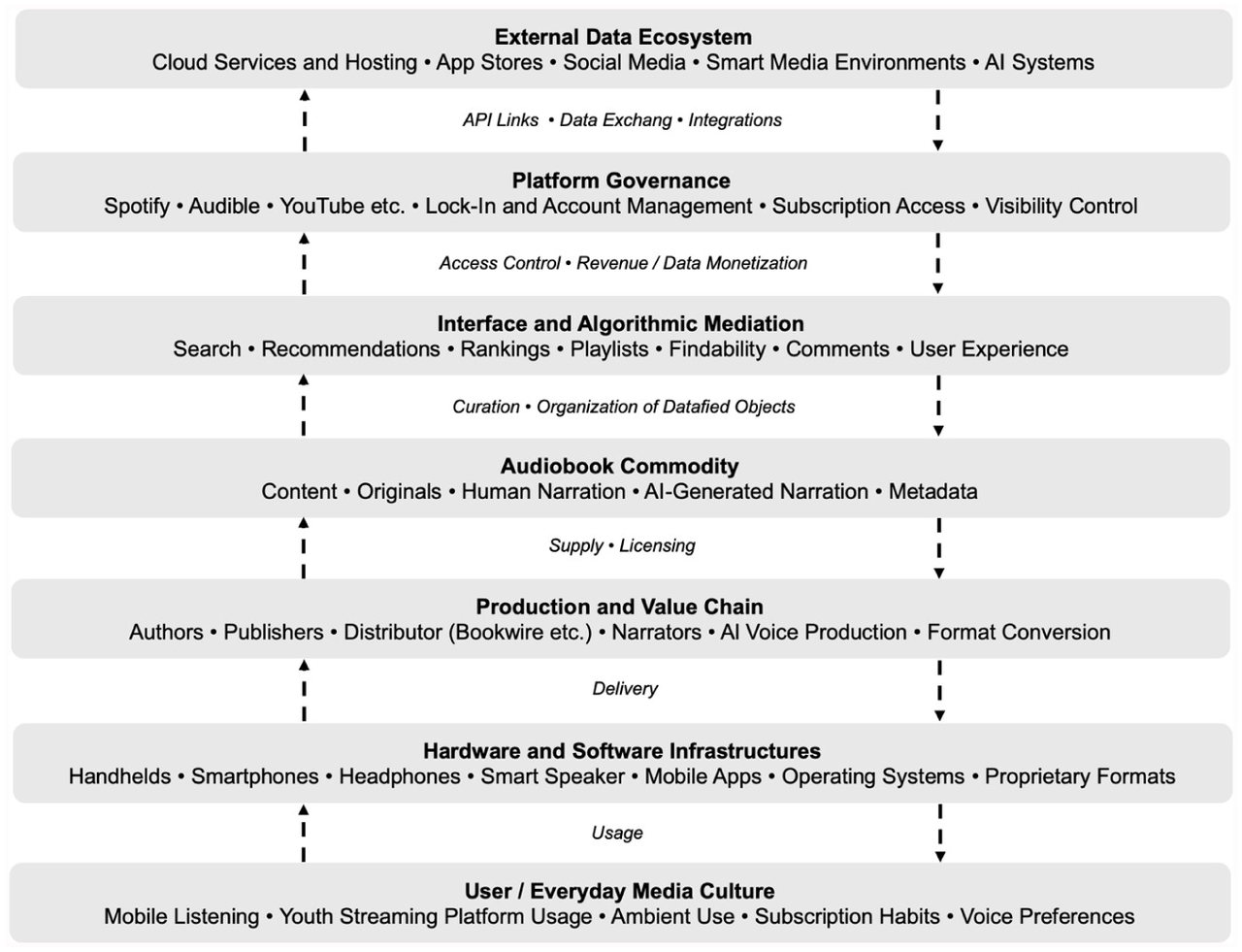
Figure 3. Ecosystem model of platformized audiobook culture (author’s own conceptual model, developed through synthesis of the literature reviewed in this article; ChatGPT was used as a conversational tool to discuss alternative visual layouts and improve readability).
Conclusion: Toward a framework of platformized audiobook culture
This article has approached the contemporary digital audiobook not merely as a technological format or a growing market segment, but as a culturally embedded phenomenon shaped by the structural dynamics of platformization. Drawing on interdisciplinary scholarship, two complementary conceptual models, and empirical developments in the German audiobook market as an analytically illuminating case, the article argues that the contemporary digital audiobook has become increasingly shaped by platform-driven transformations and should, therefore, be understood through the concept of platformized audiobook culture. In conclusion, this concept can be defined as a platform-integrated, data-driven, and mobile-oriented cultural formation in which literary audio content is distributed, accessed, and experienced through the infrastructural, economic, and algorithmic logics of digital platforms. Accordingly, the article proposes a corresponding conceptual framework and an integrative ecosystem model of platformized audiobook culture (Figure 3). However, the concept of platformized audiobook culture should not imply that all audiobook platforms operate according to the same economic or technological logic (Linkis and Pennlert, 2026: 14; Weber, 2026a: 197). Audiobooks circulate across a range of platform configurations, including all-you-can-listen subscription services such as Storytel, time-capped subscription models such as BookBeat and Spotify, and credit-based hybrid approaches such as Audible. Some providers, including Storytel, also combine multiple subscription tiers within the same platform. Likewise, platforms such as YouTube integrate audiobooks into broader advertising-driven media environments alongside diverse forms of content consumption. These differences shape content visibility, remuneration systems, and user practices in distinct ways. The concept of platformization is therefore not intended to homogenize platforms but rather to identify broader infrastructural tendencies that cut across different platform configurations, including datafication, algorithmic mediation, platform governance, ecosystem integration, and the growing dependence of audiobook production and consumption on digital platform infrastructures. Consequently, the proposed ecosystem model should be understood as a heuristic framework for analyzing diverse platform configurations rather than as a description of a single, uniform platform logic.
Platformized audiobook culture emerges at the intersection of technological infrastructures, economic business models, and everyday media practices (Berglund, 2024; Have and Stougaard Pedersen, 2020; Spjeldnæs and Karlsen, 2024). Unlike earlier audiobook cultures tied to physical carriers such as cassette tapes or CDs, the contemporary platformized audiobook is deeply embedded in networked platform environments (Linkis and Pennlert, 2026). Its cultural significance does not lie solely in the remediation of written texts into spoken form (Tattersall Wallin and Nolin, 2020), but in the way listening practices and media use are reorganized through mobile devices, subscription-based access, algorithmic recommendation systems, and continuous data extraction (Berglund and Linkis, 2022; Colbjørnsen, 2021). This conceptualization can be further specified through six interrelated dimensions.
A first defining characteristic of platformized audiobook culture is its integration into mobile media ecosystems. Audiobooks are predominantly accessed through smartphones and other connected devices that function as convergence technologies (Fortunati, 2023; Miller, 2014). This hardware layer shapes listening as a flexible, situational, and often secondary activity embedded in everyday routines such as commuting, exercising, or domestic work (Tattersall Wallin, 2022a). Listening, thus, becomes increasingly ambient, continuous, and fragmented (Spjeldnæs and Karlsen, 2024: 4815). As a result, audiobooks align closely with temporal patterns of digital everyday life, emphasizing convenience, availability, and mobility over linear or immersive engagement. This shift also contributes to the broadening of audiobook audiences, including younger users and groups previously underserved by print-centered book cultures (Linkis and Pennlert, 2026: 3).
Second, while digital book culture can be seen as more broadly rooted in “traditions of the sociology of literature and book history” (Berglund, 2024: 5), platformized audiobook culture, as discussed here, continues to develop in distinctly platform-native ways. Platformized audiobooks are accessed almost exclusively through proprietary or semi-proprietary software environments in the form of mobile apps and streaming services (Linkis and Pennlert, 2026). These platforms do not simply distribute content; they actively structure how audiobooks are found, consumed, and valued (Linkis, 2025). Interface design, navigation systems, search functions, and recommendation algorithms govern user interaction and shape listening trajectories (Sullivan, 2019). Cultural visibility is increasingly determined by algorithmic curation rather than by editorial selection or physical display, leading to new hierarchies of attention within audiobook catalogs. Consequently, platformized audiobook culture is inseparable from platform governance and from the economic and technical power of a small number of global platform providers.
A third key characteristic is datafication as a constitutive cultural process (van Es and Schäfer, 2017; van Dijck, 2014). In platformized audiobook culture, listening is continuously translated into data. Consumption patterns, listening duration, skipping behavior, and completion rates are tracked, analyzed, and fed back into platform systems. These data flows serve multiple functions: they inform recommendation algorithms, shape interface design, influence licensing strategies, and increasingly affect decisions about content production and distribution (Berglund and Linkis, 2022: 9–16). In contrast to traditional book markets, where sales figures provided only limited insight into actual reading practices, digital platforms generate “granular” knowledge about user behavior (Murray, 2021: 978). This intensifies the role of predictive analytics and contributes to a feedback loop in which past behavior increasingly conditions future cultural exposure (p. 982). From this perspective, datafication is not merely a technical process but a cultural one. Similar to what Hallinan and Striphas (2016) describe as “algorithmic culture,” recommendation systems, rankings, and personalized interfaces do not simply respond to user preferences; they actively shape cultural visibility and participation. In platformized audiobook culture, the everyday production of meaning (Williams, 2001) associated with listening practices is increasingly mediated by data-driven infrastructures (Hepp, 2013) that shape both individual engagement with audiobooks and the broader circulation and valuation of literary content.
Fourth, platformized audiobook culture is characterized by subscription-based access and the reconfiguration of economic value. In the German market, as demonstrated throughout this article, subscription streaming has become the dominant mode of audiobook consumption. Ownership is replaced by access, and individual titles are subsumed into large, continuously expanding catalogs. This economic model redistributes value within the audiobook ecosystem: while platforms benefit from scale effects, data accumulation, and user lock-in, publishers and authors become increasingly dependent on remuneration systems that privilege engagement metrics over unit sales (for discussions of other national markets, see also Berglund and Linkis, 2022; Linkis, 2025; Linkis and Pennlert, 2026). At the same time, the logic of “binge listening” (Lopez et al., 2023: 843), facilitated by subscription-based access, strengthens platform dependency and incentivizes content strategies designed to maximize listener retention and algorithmic visibility.
Fifth, platformized audiobook culture also affects the transformation of cultural labor. The role of narrators, for instance, gains prominence, as familiar voices function as branding elements within platform environments. At the same time, however, advances in AI-generated narration signal a potential restructuring of audiobook production toward greater automation and scalability. This development raises questions about quality, authenticity, and creative labor, as well as about the stratification of audiobook markets into premium, human-narrated content and lower-cost synthetic alternatives (Frankfurt Book Fair, 2025: 42–43). Platformized audiobook culture thus becomes a site where technological innovation, economic efficiency, and cultural value are negotiated.
Sixth, platformized audiobook culture is embedded in wider platform ecosystems and infrastructural dependencies. Streaming platforms operate within layered technological stacks that include operating systems, cloud infrastructures, and cross-platform integrations. User accounts, payment systems, smart home devices, and social media connectivity extend listening beyond the audiobook app itself and embed it into broader digital lifestyles. This external integration amplifies network effects and reinforces platform dominance, while simultaneously reducing user autonomy and increasing dependency on proprietary ecosystems (Colbjørnsen, 2021).
The German audiobook market provides a particularly illustrative case for this development. Its strong orientation toward subscription streaming, the dominance of global platforms, and the rapid decline of physical formats exemplify how platformization restructures national audiobook cultures. At the same time, the German context underscores that platformized audiobook culture does not unfold uniformly across linguistic or cultural markets. Instead, it interacts with local publishing traditions, and audience expectations, producing specific configurations of platform power and cultural practice.
As a concluding perspective, conceptualizing platformized audiobook culture highlights the need to move beyond format-centered or market-centered analyses. Platformized audiobooks are best understood as elements of complex sociotechnical systems in which technology, economy, and culture are tightly interwoven. Future research can build on this framework to examine questions of cultural diversity, algorithmic bias, labor conditions, and regulatory intervention within platformized audiobook environments. By situating audiobooks within the broader dynamics of platform societies, platformized audiobook culture can serve as a productive lens for understanding how audio content – and, potentially, literature more broadly – is being reshaped in the age of data-driven media.
Nevertheless, the methodological approach adopted in this article – an integrative review (Torraco, 2005) – also has certain limitations. While the reliance on secondary sources and conceptual synthesis enables a broad interdisciplinary perspective and supports theory development, it cannot directly capture the experiences, practices, and perspectives of platform users, publishers, authors, narrators, or platform operators. Furthermore, the analysis is strongly informed by developments in the German audiobook market, and the transferability of these observations to other national and linguistic contexts requires further empirical investigation. In addition, industry reports and market statistics often reflect the interests, priorities, and data availability of major market actors, potentially overlooking less visible practices, alternative platforms, or emerging forms of audiobook production and consumption. The primary objective of this article is therefore conceptual rather than empirical. By synthesizing existing research and secondary data, it seeks to provide a discussion and conceptual definition of platformized audiobook culture, together with an analytical ecosystem model. Future empirical research is needed to test, refine, and further develop this framework across different platform environments and market contexts.
Declaration of conflicting interests
The author declared no potential conflicts of interest with respect to the research, authorship, and/or publication of this article.
Funding: The author received no financial support for the research, authorship, and/or publication of this article.
ORCID iD: Sven Stollfuß https://orcid.org/0000-0002-5008-9547
This article is distributed under the terms of the Creative Commons Attribution 4.0 License which permits any use, reproduction and distribution of the work without further permission provided the original work is attributed as specified on the SAGE and Open Access pages.

Sven Stollfuß is professor of Media Change with a focus on book culture and digital publishing at Leipzig University, Institute of Communication and Media Studies. He received his PhD in media studies in December 2012 at Philipps–University Marburg, Germany. His research areas include social media, digital media and book culture, platformization of media, book and publishing cultures, AI and algorithmic processes in digital publishing, and social TV.