Audiobooks are a habit, attention is the bottleneck
Data insights from BookBeat at Frankfurt Book Fair 2026
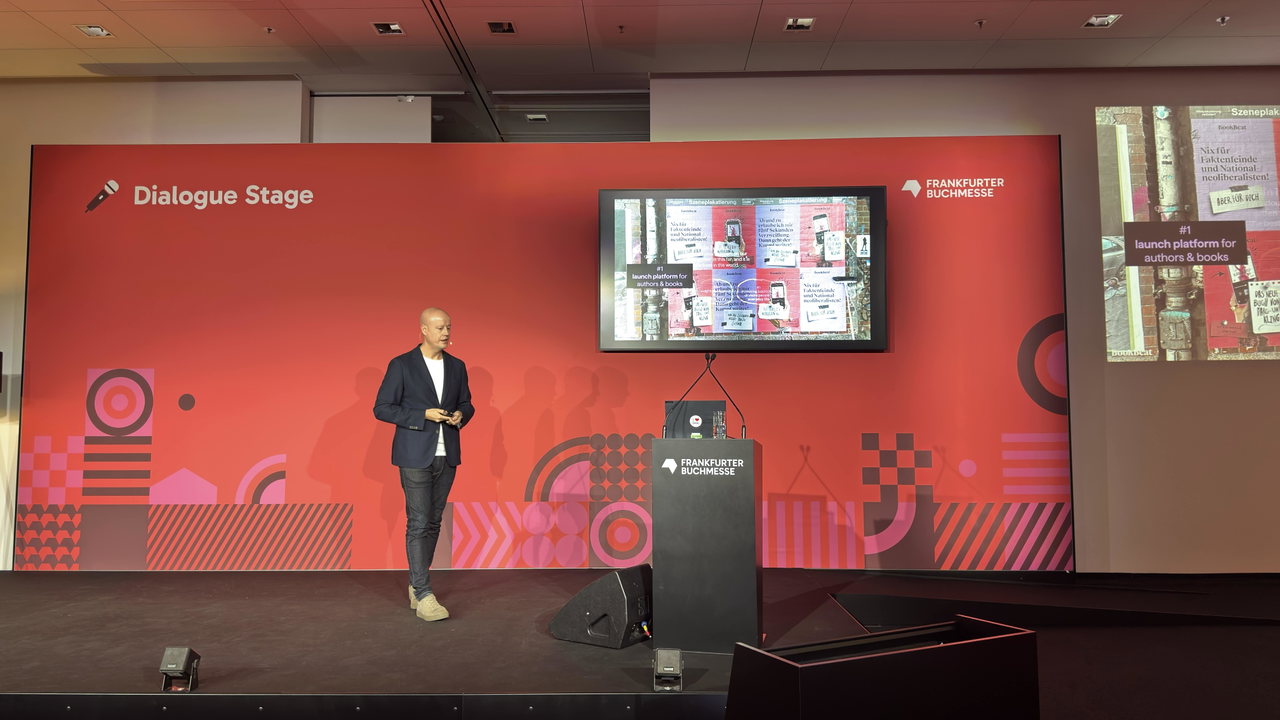
In his fourth annual data talk at Frankfurter Buchmesse, BookBeat CEO Niclas Sandin argued that audiobook growth now depends less on catalogue size than on relevance: of 50,520 audiobooks published on BookBeat in the past twelve months, the top 5,000 account for 85 percent of all starts. BookBeat is known for sharing a great deal of its data with publishers, which is why Sandin's keynote is always particularly attractive for the industry.
Published: 10 October 2026 | Photos: Daniel Lenz
A habit, not a hype
Sandin's opening claim was that audiobooks have become a stable part of daily life once listeners have acquired the taste. BookBeat showed its users' typical week three times, for 2025, September 2024 and September 2026, and the shape barely changed: commuter peaks in the morning and late afternoon, a small lunchtime bump, the heaviest listening at the end of the day, a dip on Friday and Saturday and a rebound on Sunday.
A three-year view of the seven-day average in BookBeat's three largest markets (Sweden, Finland, Germany; 2023 to 2026) tells the same story. Listening drops around Christmas, spikes in January and picks up again after the summer. Sandin said the average difference between Finland, the highest, and Germany over the three years is only 3.4 percent. The slide has no y-axis, so that figure rests on his statement alone. Germany's visible summer 2026 dip carries the slide's own label "World Cup Anxiety?".
The Netherlands, Poland and the UK are growing fast but are still converging on the older markets' behaviour. Sandin's caution: an average across markets can hide that building a habit takes time.
This content is blocked by your cookie settings. 🍪
You can change this in the cookie settings or accept and load it for this visit only.
Scale: 1.5 billion hours
Such habits add up to large volumes:
BookBeat passed 1.5 billion hours of listening and reading at the end of August 2026, and the cumulative total has grown by more than 50 percent in just two years, according to the company's press release. Users now spend about one million hours a day on the service, and Sandin said more than 90 percent of that is listening rather than reading.
The company reports more than 1.2 million paying users across ten markets. Sandin put the figure at almost 1.3 million on stage. The hours come from more than 200,000 authors and well over 10,000 publishers. In the keynote, Sandin said BookBeat has paid out more than 500 million euros to publishers since launch and that an average audiobook runs about eight hours. Neither number appears on the slides shown.
Five authors have passed 10 million listening hours across all languages and markets: J.K. Rowling, Lucinda Riley, Lars Kepler, Camilla Läckberg and Rebecca Yarros. The most-listened title ever is Harry Potter and the Order of the Phoenix; six more Harry Potter volumes, Yarros's Fourth Wing and Iron Flame and Delia Owens's Where the Crawdads Sing complete the top ten. The most popular genres are crime and thriller, novels, romance, fantasy, and non-fiction and guides.
A flooded catalogue
Growth has a price: competition. BookBeat counted 577,897 audiobooks with listening, accumulated, by September 2026, up 102 percent from 286,108 in 2021. An audiobook published today, in Sandin's words, competes with every book ever published.
The concentration is steep. Of the 50,520 audiobooks published in the past twelve months, the top 5,000 (10 percent) account for 85 percent of all starts. The other 45,520 titles share the remaining 15 percent. Sandin stressed that this is not a result of BookBeat promoting hits: its algorithms search the whole catalogue, but a book people love compounds its reach.
On stage he added that the number of authors with listening has risen 114 percent since 2021 and the number of publishers 110 percent, while users spend a steady 20 to 25 hours a month on books. Attention is a limited supply. Interest peaks early, when a title is discussed and ranks on top lists, and later new releases compete for the same peak. In maturing markets, he said, backlist strategies deliver less than in emerging ones, where catalogue still matters a lot.
Local language rules, translation is rising
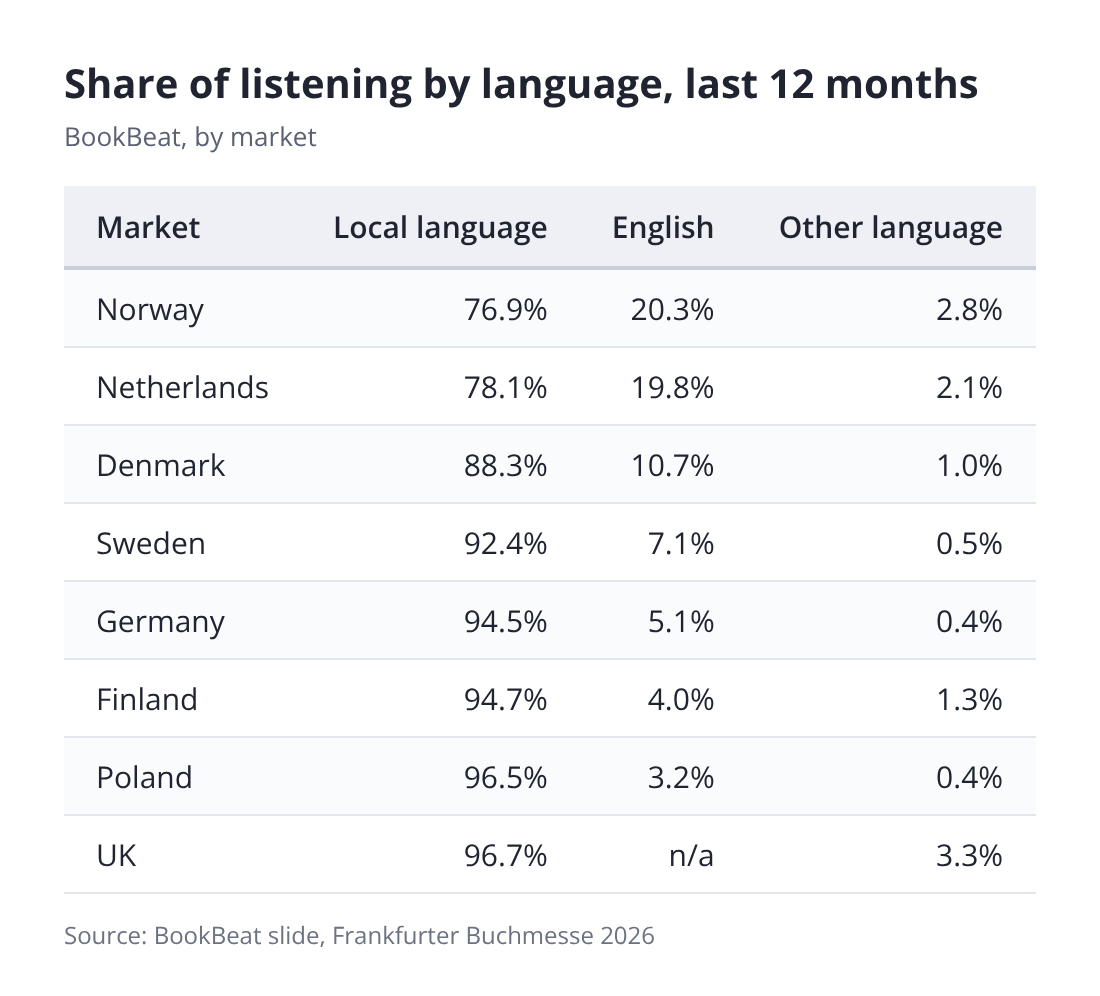
Share of listening by language, last 12 months (BookBeat slide).
Streaming audio remains a local-language game. In most markets more than 90 percent of listening is in the local language. Norway (76.9 percent) and the Netherlands (78.1 percent) are the "English Appreciation Club", as the slide puts it. Sandin contrasted this with print, where in some markets well over 20 percent of sales are in English.
Sandin attributed Norway's English share to a rule that keeps new books off streaming services for their first year, which pushes listeners towards English titles. He called it a cautionary tale for any market that debates such rules.
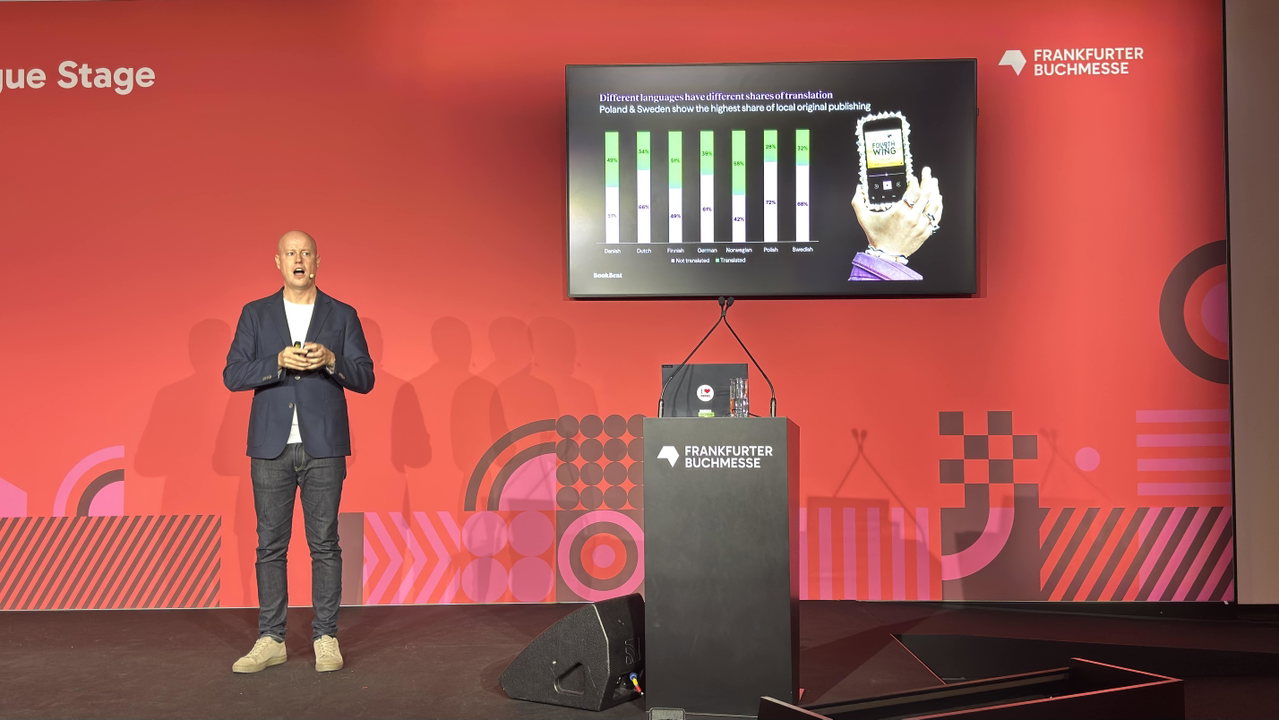
Within the local-language share, translated titles make up a large part of listening. Sandin said that in most markets around half of listening is to translated titles, with Norway the outlier and Finland also high, while Sweden and Poland go against the trend.
Translated titles matter more every year. Of the audiobooks BookBeat published in 2026, the translated share of listening rose in most markets, with Sweden the exception.
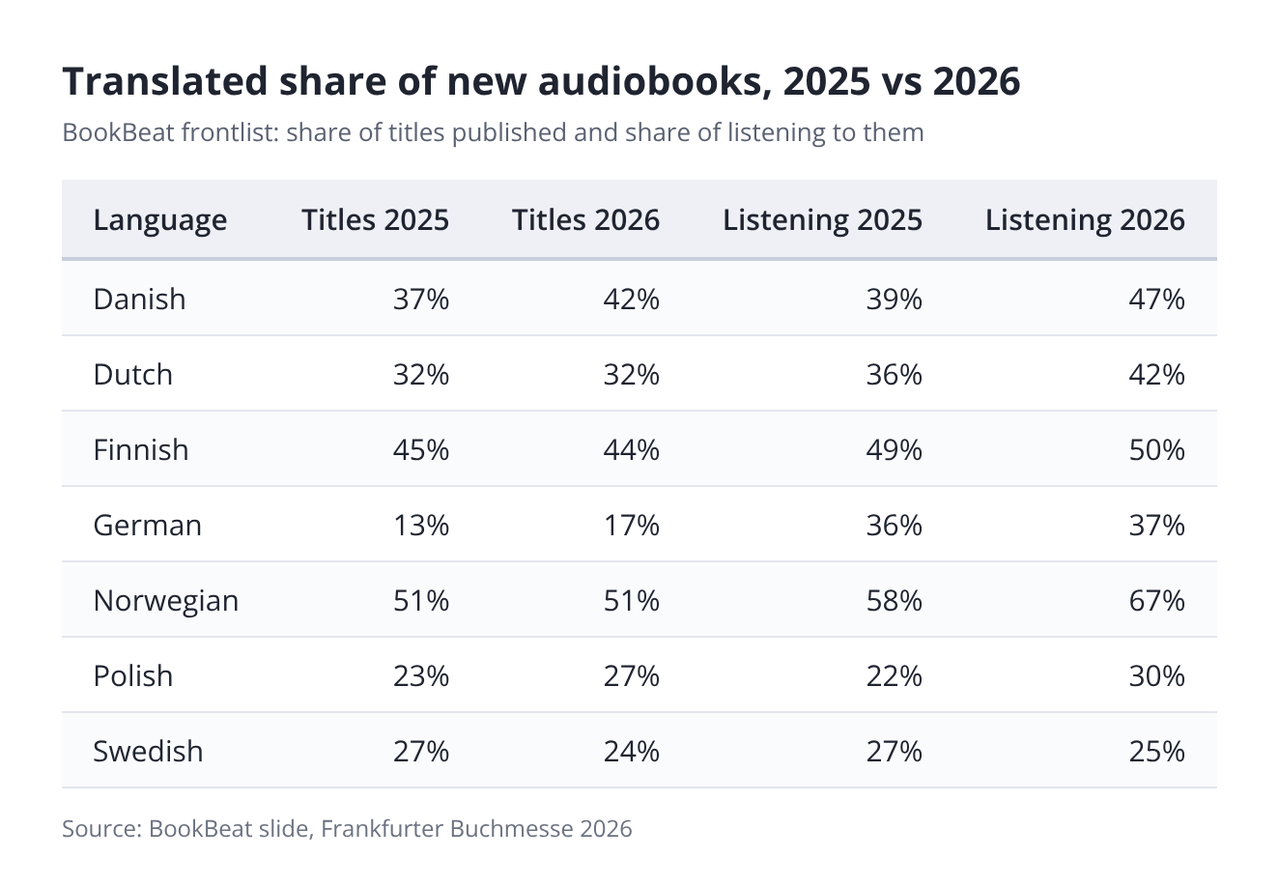
Germany stands out: only 17 percent of new releases are translations, yet they draw 37 percent of listening to new titles. Sandin partly credits AI for faster translation, alongside more platforms building catalogue. Sweden is the exception: only 25 percent of new releases are translations, and they draw a similar 25 percent of listening. Sandin put this down to the huge volume of Swedish crime published by local publishers, which leaves little room for translated titles.
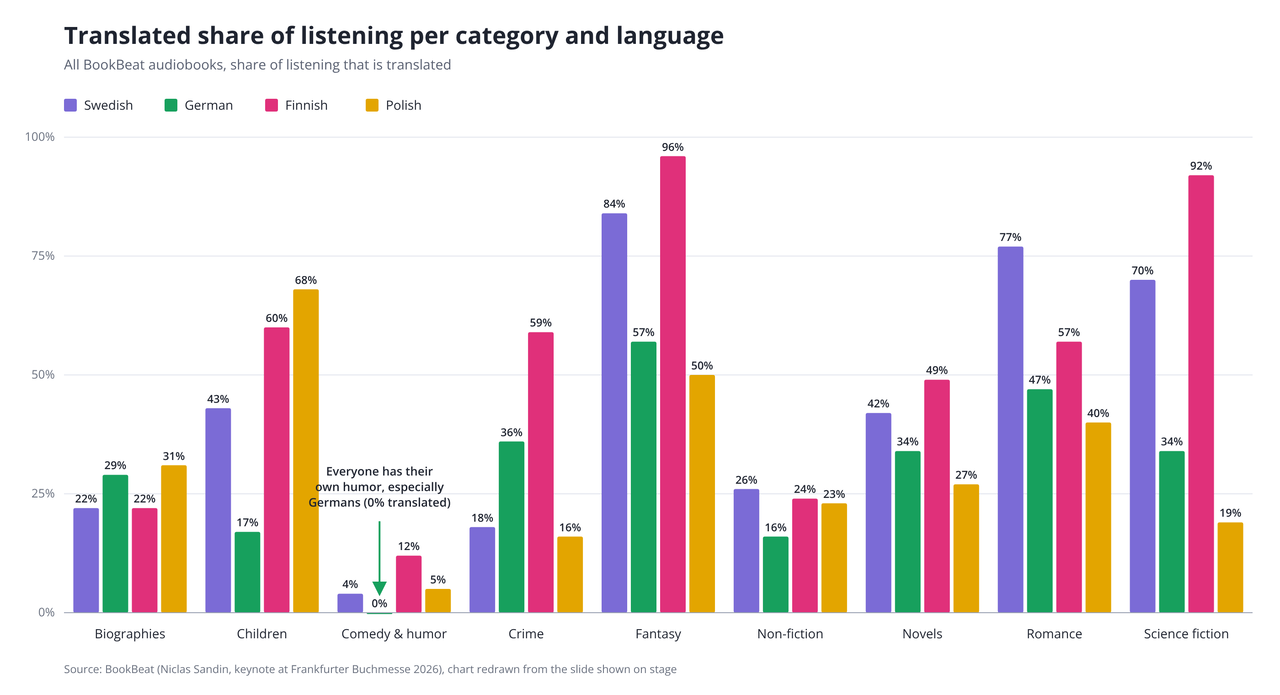
Category matters as much as market. Across all languages the translated share of listening is highest in fantasy (67 percent) and romance (54 percent), followed by children's titles (50 percent) and science fiction (45 percent). It is lowest in comedy and humor (5 percent), with biographies, non-fiction and true crime at 23 percent. Sandin's joke: everyone has their own humor, especially Germans, where translated comedy accounts for 0 percent of listening on BookBeat. He tied the strength of translations in fantasy and romance to TikTok trends and to books reaching new markets faster while their relevance peaks.
AI narration: lots of volume, little listening
Sandin's verdict on AI is that it has not changed the game yet. In 2026, 7.0 percent of new audiobooks on BookBeat are AI-narrated, a sharp rise on recent years, but they account for only 0.4 percent of listening to new titles. BookBeat can only identify the AI content that is labelled, so the real share may be higher.
He knows of one clear commercial success so far, in Finland. After a major Finnish author died, her publisher produced, as she had allowed, an AI narration in her own voice as an additional version of her book. It earned the same narration rating as the human version and brought in new listeners.
The lesson he drew: AI narration works when it adds relevance, and it hurts when it only cuts cost. A voice listeners do not recognise or love can reduce how much of a book they consume. Beyond faster translation, BookBeat has seen limited effect from AI on what users listen to, and Sandin added that this holds "so far".
What makes an audiobook work
From 1.5 billion hours of data, BookBeat tracks seven dimensions that explain why a title succeeds: relevance (how many users start), early drop-off, finish rate, separate book and narration ratings, a demand-versus-discovery index (saves driven by search or by BookBeat's own discovery), a "pretentious index" (books saved to show off taste rather than to listen to) and a loyalty index (do listeners build a habit). Finish rate matters commercially because on most markets BookBeat pays publishers by hours consumed.
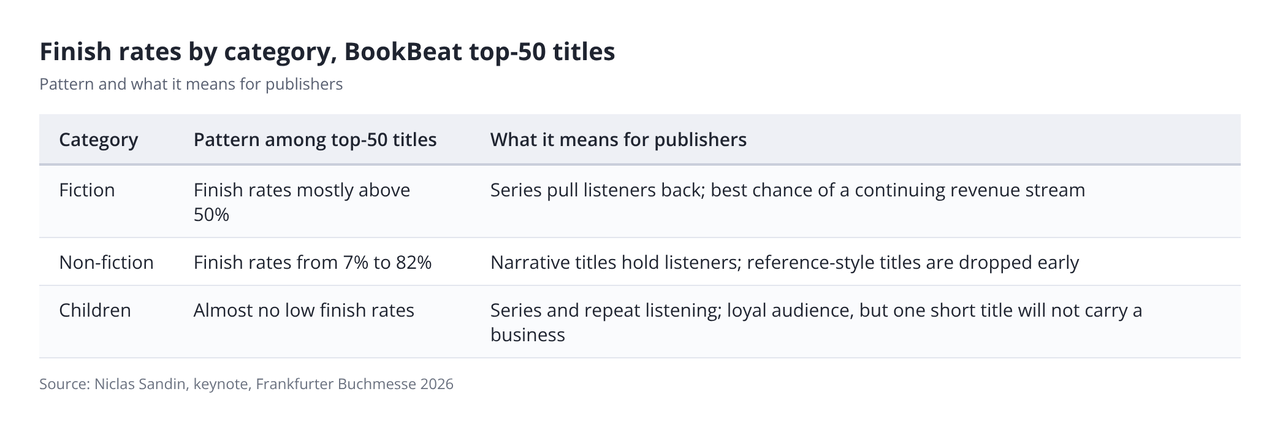
Plotting relevance against finish rate for the top 50 titles of all time shows that categories behave differently. Across the top 50, some titles reach a finish rate of about 84 percent, while the most-started book ever finishes at only 34 percent. By category:
There is no single formula, Sandin said: his "10 million hour club" mixes a boy wizard, family sagas, Nordic crime and romantic fantasy. Among the top 15 non-crime authors, Rowling is in a league of her own with almost twice the listening hours of number two, Riley, while Yarros rose from almost nothing to the top ranks within four years. The top 15 crime authors skew Nordic, with Polish and Finnish names and Freida McFadden among them.
His advice on lists: do not build a separate audio list. Swedish sales data for 2025 show streaming, over 90 percent of it audio in Sweden, delivering around half or more of the revenue of the country's top-selling authors, and the strongest authors are present across several formats and channels. Instead of a different list for audio, publishers should make their existing commercial authors bigger in audio. Tastes remain local: of the trending lists in Sweden, Germany, Poland and the UK in the week before the keynote, only one author, McFadden, appeared on all four.
Sandin closed with examples of what he called real publishing: the launch campaign for Marc-Uwe Kling's Kangaroo Chronicles in Germany (six hours), a Polish bestseller about a peasant woman, Rebecca Yarros's Onyx Storm (29 hours) and the biography of a Finnish hip-hop artist that became BookBeat's biggest non-fiction success in Finland last year, although nobody had asked for it. None of these would have been picked by AI or by looking in the rear-view mirror, he said; they came from publishers acquiring rights and believing in them on a local market.
Why exclusivity is a weak growth strategy
Sandin used the data to argue against exclusive deals, which publishers often link to better placement in an app. His reasoning: relevance peaks right at release, when a title is discussed and charting. His chart of starts for titles released in September 2025, followed over their first 365 days, was meant to show that early peak. A book available everywhere can reach all potential listeners at that moment. Exclusive to one established service, it loses by his estimate around 70 percent of them; exclusive to a new service, it loses almost all.
The loss compounds. Waiting does not help, because the next wave of releases competes for the following peak, and a listener who had to switch service for one release is less likely to find the author's next one. Sandin's conclusion: in the long run exclusivity mostly leads to a smaller audience for authors. He credited Spotify, which presented before him, for not going exclusive.
The argument comes from a platform whose model depends on broad availability, and publishers will weigh it against the terms any exclusive offer carries.
Where Audible and BookBeat set different accents
Audible used the same fair to present its "Future of Listening" study, a NielsenIQ survey of 18,000 people aged 18 to 64 in 11 countries, covering audiobooks, podcasts and audio series. Read next to Sandin's keynote, it agrees on much, such as the pull of favourite narrators and the role of social media and word of mouth in discovery. On two points, however, the two companies stress different things.
Invest now versus attention is scarce: Audible's Rachel Ghiazza told publishers that demand is established and that investing in audio now is the better bet: "The time is now." The study backs this with self-reported growth, as 34 percent of listeners worldwide consumed more spoken-word content than a year earlier. Sandin does not dispute the growth, but his data points to what follows from it. With 50,520 new titles in twelve months, 85 percent of starts going to the top 5,000 and users spending a steady 20 to 25 hours a month on books, he warns that a title must stand out at release to be heard at all. For publishers the message is not whether to invest, but how to be relevant when they do.
AI as a cost lever: Ghiazza described AI as one tool in a wider strategy, not a replacement for human performers. It could close the gap between titles available in print and in audio, particularly across languages, and savings could fund more audiobooks. Sandin agrees on translation, but he treats narration differently: AI makes up 7.0 percent of new titles and 0.4 percent of their listening, and replacing a voice listeners know with a cheaper one risks losing relevance. Audible's own German respondents are cautious as well, as 58 percent want exclusively human voices.
The two sources also measure different things. Audible's figures are survey answers commissioned by the company, whereas Sandin's come from usage data of one service.
Takeaways for publishers
Listening habits are stable and converging across markets; what differs between markets is maturity and the options available to users.
With 50,520 new titles in twelve months and 85 percent of starts going to the top 5,000, relevance at release decides success.
Translations are gaining share, especially in fantasy and romance; comedy and humor rarely travel, and Germany shows the gap between few translated releases and strong listening.
AI narration is 7.0 percent of new titles but 0.4 percent of listening; use it where it adds relevance, not only to save cost.
Build audio on existing commercial authors and series, and think twice before exclusive deals.
Sandin's closing warning: if everyone copies what worked in one market, the industry takes fewer risks instead of smarter ones.