In-car audio: Who stands to profit from the next publishing platform?
EarReality founder Christian Mahnke on the potential of a key audio distribution channel
The car provides additional listening time without audio having to compete with yet another screen. But reach alone does not generate business. Those who merely provide audio files are once again leaving discoverability, customer access and monetisation in the hands of platforms, says Christian Mahnke, CEO and co-founder of EarReality.

Published: 1 Sept 2026 | Photo: Magnific, others: Ear Reality
CarPlay, Android Auto and native in-car systems are turning the car into a digital platform. Car manufacturers are setting up app stores, voice assistants are becoming more powerful, and high-quality sound systems are becoming part of the product experience.
The key question is therefore no longer: How do audiobooks end up in the car?
Rather: Who decides what content is found, recommended and paid for? And how do publishers make money from it?
The audience is here
According to Online Audio Monitor 2025 Around 31.6 million people in Germany listen to online audio in their cars at least occasionally.
So there is no need to create the market from scratch. The question of value creation remains open.
Publishers produce content. Platforms often control search functions, recommendations, data, accounts and payments. In the car, vehicle manufacturers, operating system providers and voice assistants also play a part.
Those who simply deliver files may gain reach, but lose the customer interface.
Where does turnover come from?
Four revenue models are particularly relevant for publishers in the in-car audio sector:
Distribution: The most obvious approach is to make linear audiobooks, radio plays and podcasts available via in-car platforms as well. Revenue can be generated through subscriptions, one-off purchases, usage-based payment or revenue-share models. For publishers, this is primarily a volume-driven business: existing content reaches additional usage scenarios and potentially new target audiences. The advantage lies in the comparatively low additional effort required in terms of content. The challenge is to ensure visibility and appropriate remuneration.
Premium formats: Interactive, immersive or in-car productions can command higher prices and offer greater differentiation. Possible examples include exclusive stories, interactive audiobooks, well-known games or entertainment IPs, spatially produced content, or formats designed for families and shared journeys. Such productions can be funded through premium purchases, unlockable content, licences, sponsorship or partnerships with rights holders and vehicle manufacturers.
B2B projects: Vehicle manufacturers are increasingly looking for digital content and services with which they can differentiate their infotainment offerings. This gives rise to B2B business models: bespoke productions, exclusive content, white-label applications, technology integration or licensing models. In this model, the listener does not necessarily pay directly. Clients may also include OEMs (Original Equipment Manufacturers), platform providers, brands or entertainment companies.
Catalogue plus premium experience: The most interesting approach, from EarReality’s perspective, combines a broad linear catalogue with selected interactive and immersive premium formats. The catalogue encourages regular use, choice and reliability. Premium content builds brand profile, increases willingness to pay and creates differentiation. In short: the linear catalogue brings users back. The interactive experience generates profit margins and brand recognition.
Metadata becomes dialogue design
Another aspect is usability. Whilst driving, nobody has time to scroll through covers and categories for long. Voice control therefore becomes the primary interface.
Users will ask questions such as: “Carry on playing my last audiobook.”
“Find a fantasy story to last half an hour.”
“What story can we listen to with the children?”
The title, series, author, genre, length, target audience and tone must therefore be structured in such a way that speech recognition systems can understand them.
Metadata is becoming the basis for dialogue design in cars.
The largest catalogue remains invisible if users cannot browse it without a screen.
How can this be put into practice?
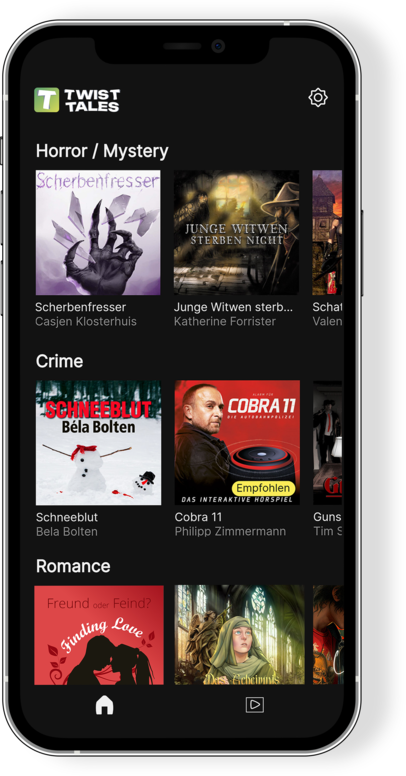
We have already tested speech-recognition-based menus with our TWIST Tales. This showed that a visual interface cannot simply be read aloud.
Four options are immediately visible on a display. When spoken, they must be heard, remembered and answered correctly. Voice-first therefore requires short options, natural responses and robust error handling.
The real innovation here is not the speech recognition itself. The key factor is whether the catalogue, navigation and content work without visual cues.
From concept car to market-ready product
At CES 2027 in Las Vegas, we will be presenting interactive audiobooks in the Dolby show car, in collaboration with Dolby.
The foundation is our market-ready TWIST Tales Automotive app. It combines linear and interactive content, voice-based navigation, immersive audio production and an application developed specifically for the vehicle.
Dolby Atmos expands the possibilities in terms of sound and narrative. However, the interplay between content, interface, language and usage context is crucial.
A high-quality sound system on its own does not make for a good automotive product.
Publishers need an automotive strategy
Not every publisher should set about building its own in-car app right now. But every audio publisher should answer three questions:
What sort of content is suitable for the car?
Which customer interface do we want to monitor?
Which business model do we want to test?
The market has not yet been established. Many questions regarding user guidance, rights, platform integration and monetisation can only be answered through real-world testing.
We are keen to share what we have learnt from TWIST Tales and the development of our automotive app, and look forward to exchanging ideas with publishers, rights holders, platforms and automotive companies.
The next audio platform is already taking shape. The publishing industry should not only supply it, but also help shape it.

Christian Mahnke is the founder and CEO of EarReality and has been developing immersive, interactive audio formats with high user engagement since 2017. As an author, he has written for Disney and Audible, amongst others, and has published a specialist book on writing interactive audio stories. In 2024, he was named an Amazon Alexa Champion. Through EarReality, he combines linear audiobooks, interactive premium formats and voice-first technology to create market-ready in-car audio solutions for publishers and automotive partners.