“Audio is not a shortcut. It is access”
Rebecca Souster (Pan Macmillan) on reaching reluctant readers
30.3.2026 | Foto: freepik.com
“Reaching Reluctant Readers via Audiobooks” is the title of one of the panels at the Audio Forum at the Bologna Children’s Book Fair on April 15. Rebecca Souster (Pan Macmillan) is among the speakers and took the time to answer our questions.
How does Pan Macmillan define “reluctant readers” today – and how has that definition changed in recent years?
Rebecca Souster: For a long time, the term ‘reluctant reader’ implied someone who simply did not like reading. It suggested resistance or a lack of interest in reading for pleasure because it did not bring enjoyment. In my experience, we don’t use the term in quite the same way anymore. To me, a reluctant reader is someone who has not yet found the right story, the right genre, or the right format. That shift in thinking is important. It moves us away from seeing the reader as the problem and instead asks whether we, as publishers, are meeting people where they are.
I feel that quite personally. I was what you would have called a reluctant reader growing up. Reading felt difficult, and I never understood why I could not immerse myself in books in the way others seemed to. I assumed I simply was not a reader. In hindsight, I suspect I had not been given stories that truly resonated with me.
Now that I have found what I love, in both print and audio, I read or listen for three to four hours a day. I cannot put books down. That experience shapes how I think about audience strategy. I genuinely believe there are no reluctant readers, only undiscovered ones.
In your experience, are reluctant readers primarily a format issue, a content issue, or something else?
It is rarely just one thing. For some people, it is absolutely format. If decoding text is tiring, whether because of dyslexia, visual stress, time pressure or habit, then print can feel like hard work rather than pleasure. Audiobooks can remove that barrier immediately. Titles such as The Lie Tree by Frances Hardinge or the InvestiGators series by John Patrick Green are great examples; the engaging narrations allow young listeners to absorb complex plots or playful humour without the strain of decoding text on a page.
For others, it is about content and relevance. Are we publishing stories that reflect their lives, their humour, their pace and their interests? Genre discovery plays a huge role.
Lifestyle is another factor. People are busy. They commute, exercise, cook and care for children. Audio fits into life in a way that print sometimes cannot.
So I would say reluctance is often about friction, and our job as publishers is to reduce that friction wherever we can.
Do audiobooks reach people who would otherwise not engage with books at all, or do they mainly deepen engagement among existing readers?
Both, and that is what makes the format so powerful. Audiobooks absolutely deepen engagement among existing readers. We see that consistently. Readers who discover audio do not abandon print. Instead, they expand their reading lives. They might listen during the week and read in print at the weekend. Audio becomes additive.
But audio also brings in people who might not otherwise engage with books at all. I am living proof of that. If audiobooks had been as accessible when I was younger as they are now, I would have discovered reading for pleasure much earlier.
Modern favourites such as The Gruffalo by Julia Donaldson show how approachable audio can be for children, while titles like Adam Kay’s This Is Going to Hurt demonstrate that adult non-fiction can capture new readers through performance and humour.
We see this with younger audiences and with adults who have not read in years but start with a recommendation in audio because it feels less intimidating. Once that door is open, it often leads elsewhere.
What makes audiobooks particularly effective as a “bridge format” compared to ebooks or print?
Audio feels human. It is, after all, the original storytelling format. There is something powerful about being told a story. It taps into something nostalgic and communal, whether that is a bedtime story or stories shared aloud across generations. For some people, it is easier to connect with a voice than with printed text.
Unlike ebooks, audio does not require visual stamina. Unlike print, it does not demand stillness. It works alongside life rather than asking you to stop what you are doing. For people who have struggled with traditional reading, audio can rebuild confidence. Being able to say, ‘I finished that book’ can be transformative. That sense of achievement can completely change how someone feels about reading.
And how do we bring these listeners from audio to other formats?
The key is not to treat formats as competitors. When someone falls in love with a story in audio, they often want to own it physically. They may buy the hardback for their shelf or give it as a gift. That is certainly true for me. From a strategy perspective, that means joined-up publishing. Simultaneous publication dates, aligned cover design, and shared marketing campaigns all matter. We should not be afraid of audio leading the conversation for a title if that is where the opportunity lies.
It also means thinking about author brand holistically. When a listener connects with a narrator’s performance, that emotional connection can transfer naturally into print and ebook. Ultimately, it is about building readers for life, regardless of format.
In the context of children and young adults, how are schools, libraries, and parents responding to audiobooks? Is there still resistance to audiobooks being seen as “real reading”, and how do you address that?
The response is shifting, and largely in a positive direction. Schools and libraries are increasingly embracing audio as part of their literacy strategy. Many recognise that a one-size-fits-all approach to reading does not work given the diversity of learners in the classroom. Research from the National Literacy Trust shows that listening is genuinely popular with young people. In 2024, 42.3 per cent of children and young people aged 8 to 18 said they enjoyed listening to audio in their free time, which was higher than the proportion who said they enjoyed reading for pleasure. In the same research, 37.5 per cent said listening to audio had sparked their interest in reading books.
Educators often describe audio as a scaffolding tool rather than a replacement. It supports comprehension, vocabulary development, and narrative understanding. For children who struggle with decoding, listening provides access to richer language and more complex stories than they might choose independently. Series such as The Treehouse Series by Andy Griffiths are often used in schools and libraries because their pacing, humour, and engaging narration draw children in and keep them listening.
There is still some hesitation about whether listening counts as reading. That concern often stems from traditional definitions of literacy that focus solely on decoding print. So we need to reframe the conversation. If we define reading as engaging with story, ideas, and language, then listening clearly qualifies. Audiobooks help children interpret tone, understand pacing, and build vocabulary. They develop imagination and comprehension. Those are core literacy skills.
Audio is not a shortcut. It is access. For children who find decoding exhausting, or who have not yet found a story that resonates in print, audiobooks can open the door. Once that door is open, many move confidently between audio, print, and digital formats as part of a richer, lifelong reading habit.
How early in the publishing process should audio be considered?
From submission.
Audio should never be an afterthought. When commissioning, editors should be asking how a book will work in audio and whether it could even be the lead format. When audio is integrated from acquisition onwards, we can think strategically about casting, simultaneous publication, and cohesive marketing across formats.
At Pan Macmillan, audio is a core format, not a subsidiary one, and that shift in mindset makes a tangible difference to performance.
During the UK’s National Year of Reading, what signals or learnings around audio stand out so far?
One clear signal is that access and flexibility matter enormously. There is growing recognition that reading does not have to look one particular way. Audio is increasingly seen as part of the wider reading ecosystem rather than something separate from it.
We are also seeing strong engagement from younger audiences who are already comfortable consuming long-form audio through podcasts. Audiobooks feel like a natural extension of that behaviour. Perhaps most encouragingly, the conversation around inclusion feels more confident. Audio is being recognised as a tool for widening participation in reading, which aligns closely with our mission as a publisher.
Are there communities or audiences audiobooks still fail to reach, and why?
Yes, and it is important to acknowledge that. Economic barriers still exist. Subscription fatigue is real, and device access or data costs can be limiting. Discoverability can also be a challenge, particularly for people who do not see themselves reflected in publishing or who are not being marketed to directly.
There is also an awareness gap. Some people simply do not realise how rich and varied the audiobook landscape has become. As an industry, we have more to do through partnerships, libraries, schools, accessibility initiatives, and inclusive commissioning.
If my own journey has taught me anything, it is that readers are everywhere. Sometimes they just need the right door opened. Increasingly, audio is that door.

Rebecca Souster has extensive experience in the publishing and audio industries, spanning both corporate and entrepreneurial environments. She has held senior leadership roles for over a decade, including Managing Director at Lume Books and Head of Global US, UK, and Emerging Markets at Zebralution, where she oversaw strategy and growth across multiple territories. She is currently Head of Audio Sales Strategy at Pan Macmillan, leading audio sales initiatives and strategy at one of the UK’s leading publishers. Rebecca is also the founder of Break the Habit Press, reflecting her commitment to championing fresh voices in publishing.
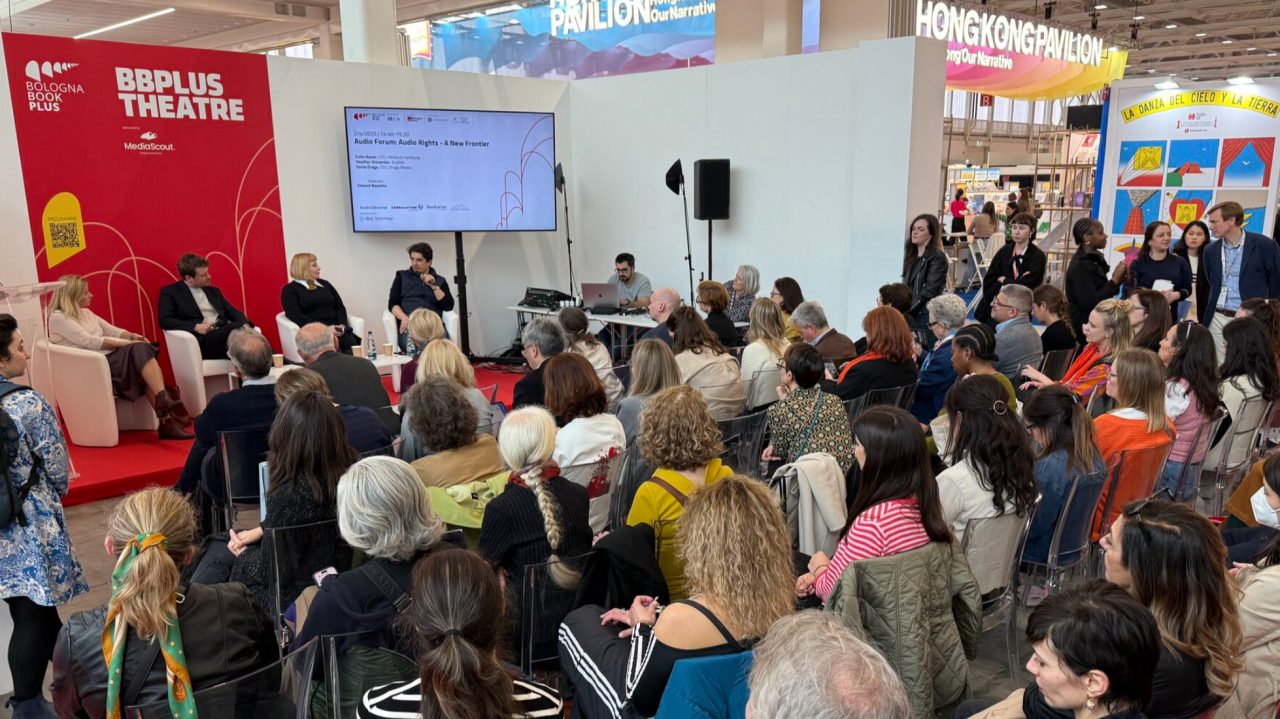
Photo Nathan Hull
Audio @BolognaBookPlus
This year’s Audio Forum’s programme at Bologna book fair will examine how technology, creativity, and commercial realities are reshaping how stories are produced, distributed, and consumed. The Audio Forum 2026 is sponsored by ElevenLabs, Bookwire, and Zebralution. It takes place Wednesday 15 April 2026 in the BolognaBookPlus Theatre.